
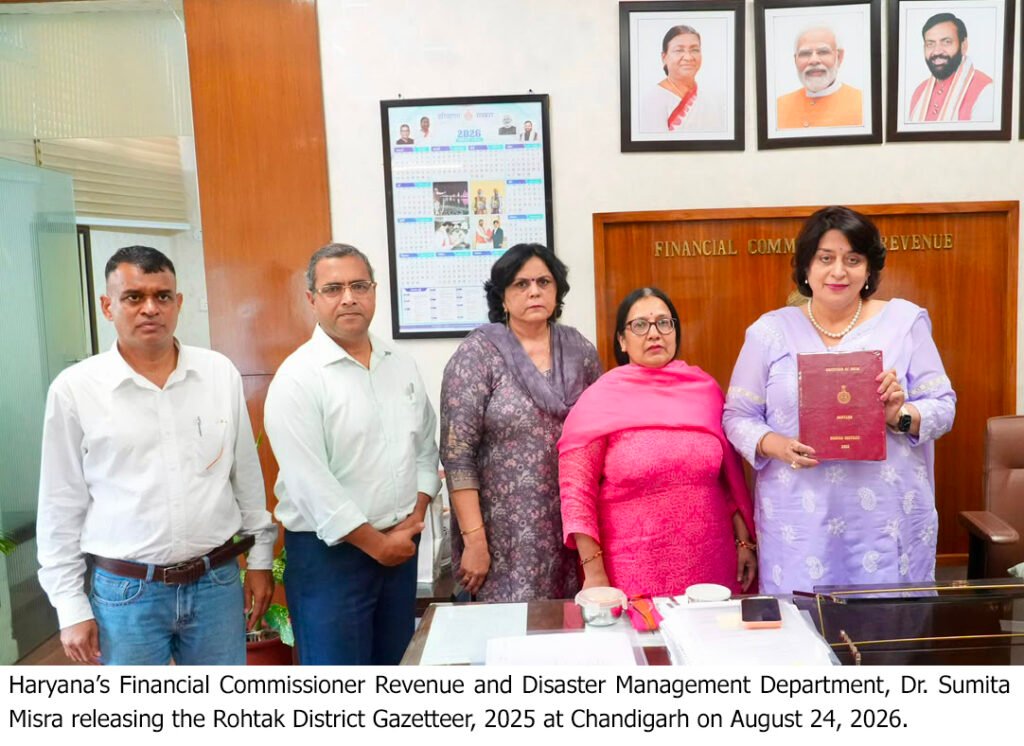
Chandigarh, August 24 – Haryana’s Financial Commissioner Revenue and Disaster Management Department, Dr. Sumita Misra released the Rohtak District Gazetteer, 2025 today at her office in the New Haryana Civil Secretariat, Sector 17, Chandigarh.
This nearly 650-page publication, 15th publication in the series of District Gazetteers brought out after Haryana was carved out as a separate State in 1966, is the first revised edition of the Rohtak District Gazetteer published in 1970. The publication contains 19 chapters spread over 484 pages with an appendix of 72 tables and 40 pages of colourful illustrations.
Dr. Sumita Misra said that District Gazetteers serve as “miniature encyclopaedias”, providing comprehensive and authentic information on a district’s geography, demography, society and culture, history, economy, administration and development.
It also records reference of Rohtak with its ancient name ‘Rohitaka’ in the Mahabharata during the western expedition of Pandava warrior Nakula. The area was believed to have been covered by a forest of the ‘Roherra’ tree, known as ‘Rohitaka’ in Sanskrit.
Archaeological evidence indicates that the Rohtak region was inhabited from early times and emerged as a centre of cultural and political activity. The Gazetteer notes that archaeological sites in the area have been associated with settlements linked to the Indus Valley Civilisation, while the ancient mounds at Khokhrakot are believed to stand over remains associated with the Harappan Civilisation.
The Gazetteer traces political history of Rohtak district through successive regimes. The area came under the broader control of Prithvi Raj Chauhan III of the Chahmana dynasty, before passing under the control of Muhammad Ghauri following the Chauhan defeat in 1192 AD. During the Delhi Sultanate and Mughal periods, the area was frequently assigned as a military jagir to nobles. Following the Treaty of Surji Anjangaon signed on December 30, 1803, the Rohtak area, along with other territories of Maratha chief Daulat Rao Scindia west of the Yamuna, came under the control of the British East India Company.
In 1948, the district assumed its form, as a part of erstwhile Punjab, following the merger of the erstwhile Dujana State. On November 1, 1966, when Haryana was formed as the 17th State of the Union of Indian, Rohtak was among the seven original districts of the new State. At that time, the district comprised of Rohtak, Sonipat, Gohana and Jhajjar tehsils and Nahar sub-tehsil. Subsequently, Sonipat was carved out on December 22, 1972, and Jhajjar on July 15, 1997 as a separate districts from the then Rohtak district.
The revised Gazetteer records development in Rohtak district, especially during past five decades, covering vivid fields like history, people, agriculture and allied activities, industry, banking, trade and commerce, transport and communications, infrastructure, law and justice, healthcare and tourism, emergence as an important hub education and of medical facilities, sports and infrastructure besides, its growing importance within the National Capital Region and its connectivity with Delhi and adjoining areas.
She said such publications are valuable reference material for administrators, planners, researchers, journalists, tourists and the general public. She expressed hope that the revised Rohtak Gazetteer would prove useful to scholars, historians, social scientists and civil society.
The Rohtak District Gazetteer will be available at the Sale Depot, Printing and Stationery Department, Government Press, Sector-6, Panchkula. To ensure wider access to this valuable record of the district’s history, heritage and development, copies will also be made available in district libraries and State universities across Haryana.
In another new initiative, Dr. Misra informed that the Gazetteer will also soon be available online through the Revenue Department’s official website, https://revenueharyana.gov.in/, enabling researchers, students, historians and the general public to access this comprehensive account of Rohtak’s historical and contemporary journey.
Dr. Misra appreciated the Deputy Commissioner, Rohtak and district administration for their consistent support, and expressed her gratitude to the heads of various autonomous institutions and agencies; various Central and State government departments, who helped in providing in-depth information and vital material related to their respective fields for preparation of the District Gazetteer.
The FCR appreciated the consistent efforts put in by Sh. Kamlesh Kumar Bhadoo, State Editor Gazetteers-cum-Secretary Revenue; Smt. Rajni Gupta, Joint State Editor; Sh. Surender Kumar, Editor; and Assistant Editors Sh. Surinder Singh Sewal, Smt. Amita Arora, Sh. Rajesh Singh, Smt. Roshni Devi and Smt. Meenakshi Kalra, along with the officials and staff of the Gazetteers Organisation of the Revenue and Disaster Management Department, Haryana who have been instrumental in bringing out the publication.